
Summary
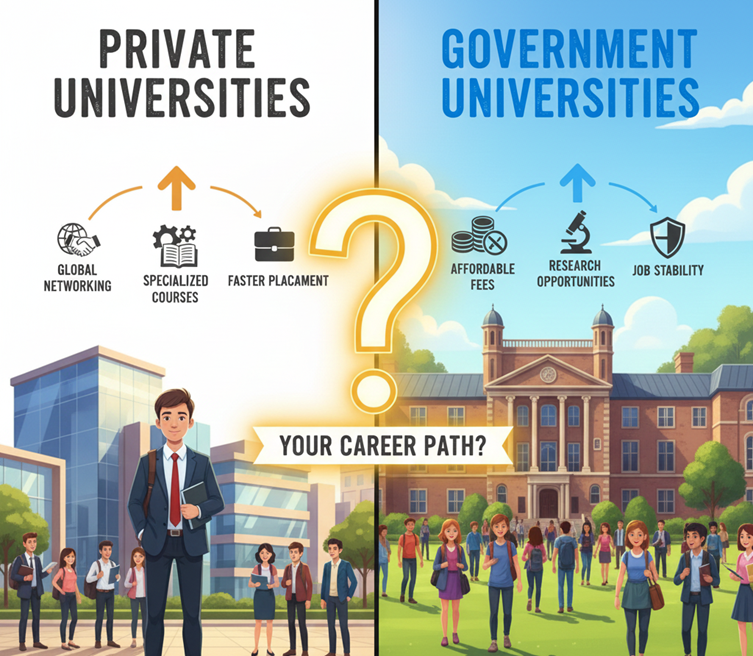
The debate between private and government universities is one of the most confusing decisions students face after 12th class. Should you go for the affordable, traditional route of a government university, or invest more in a private institution with modern facilities? This comprehensive guide breaks down every aspect of both options—from fee structure and infrastructure to placement opportunities, faculty quality, and return on investment. We’ll explore the real differences beyond the stereotypes, help you understand which type suits different career goals, and provide a practical framework for making this crucial decision. Whether you’re budget-conscious or willing to invest in premium education, this article will help you see through the marketing hype and make a choice that truly aligns with your career aspirations and financial reality.
The Great University Debate: Why Everyone Has an Opinion
Walk into any gathering of Indian parents, and you’ll hear it. “Government college is the best—low fees, good value!” says one uncle. “No, no, private universities have better placements and facilities,” argues another aunty. Everyone seems to have a strong opinion, and guess what? They’re all partially right.
Here’s the thing—there’s no universal answer to whether private or government universities are better. It’s like asking, “Which is better: a bicycle or a car?” Well, it depends on where you’re going, what you can afford, and what matters most to you.
The truth is, both private and government universities have produced successful professionals. Both have their champions and their failures. What matters is finding the right fit for YOUR specific situation, career goals, and financial circumstances.
So let’s cut through the noise, bust some myths, and look at the facts. By the end of this article, you’ll have clarity on which path makes sense for you.
Understanding the Basic Differences
Before we dive deep, let’s get the fundamentals clear.
What Defines a Government University?
Government universities are funded and managed by state or central governments. Think IITs, NITs, Delhi University, Mumbai University, or your state universities. They’re established through government acts and receive regular funding from public funds.
Key characteristics:
- Lower fee structure (subsidized by government)
- Admission usually through competitive entrance exams
- Regulated fee hikes and policies
- Often have a longer legacy and established reputation
What Makes a Private University Different?
Private universities are established by private bodies through state legislature acts, though they’re still regulated by UGC (University Grants Commission). Examples include Manipal University, BITS Pilani, Amity University, or Ashoka University.
Key characteristics:
- Higher fee structure (self-financed)
- Mix of entrance exams and management quota seats
- More flexibility in curriculum and operations
- Often newer with modern infrastructure
Now that we’ve got the basics down, let’s compare them on factors that actually matter to your career.
Fee Structure: The Elephant in the Room
Let’s talk money first because, honestly, it’s often the deciding factor for most families.
Government Universities: Easy on the Wallet
The biggest advantage of government universities? Affordability. A four-year engineering degree at an NIT might cost you ₹8-10 lakhs total. At top universities like Delhi University, a three-year undergraduate degree could cost as little as ₹30,000-50,000 for the entire course.
This low fee structure is a game-changer for students from middle-class or economically weaker backgrounds. It means less financial burden, minimal or no education loans, and the freedom to choose your career path without the pressure of recovering massive investments.
Private Universities: A Significant Investment
Private universities don’t pull punches when it comes to fees. The same engineering degree could cost anywhere from ₹12 lakhs to ₹25 lakhs or even more at premium private institutions. Medicine, law, or management programs can go even higher.
But here’s what private universities will tell you: you’re not just paying for education—you’re investing in infrastructure, industry exposure, modern facilities, and sometimes, better placement support.
The Real Question: Is the Price Difference Justified?
This is where you need to do the math. If a government university costs ₹5 lakhs and a private one costs ₹20 lakhs, that’s a ₹15 lakh difference. Will the private university provide opportunities, placements, or experiences worth that extra investment?
Sometimes yes, sometimes no. We’ll explore this more in the sections ahead.
Infrastructure and Facilities: Where Modern Meets Traditional
Government Universities: A Mixed Bag
Here’s an honest take—infrastructure at government universities varies wildly. IITs and NITs have world-class facilities. But many state universities? Not so much.
You might find:
- Libraries with extensive collections but outdated digital infrastructure
- Functional labs, though equipment might not be the latest
- Large campuses with good sports facilities
- Hostel facilities that are affordable but basic
- Bureaucratic processes that take forever
The infrastructure often reflects the institution’s age. Older universities have a certain charm and legacy, but sometimes lack the modern amenities today’s students expect.
Private Universities: The Wow Factor
Private universities often win the infrastructure game, at least visually. You’ll typically find:
- Modern, air-conditioned classrooms with smart boards
- State-of-the-art labs with latest equipment
- Well-maintained libraries with extensive digital resources
- Better hostel facilities (though more expensive)
- Modern cafeterias, gyms, and recreational facilities
- Faster administrative processes
But here’s a reality check—beautiful buildings don’t guarantee quality education. Don’t get dazzled by fancy campuses. Infrastructure should enhance learning, not replace it.
Faculty Quality: Where Knowledge Lives
This is crucial, and it’s where things get interesting.
Government Universities: Experience and Stability
Government universities often have professors who’ve been teaching for decades. This brings:
Advantages:
- Deep subject knowledge and research experience
- Stability (professors aren’t leaving for better-paying jobs frequently)
- Strong academic credentials and publications
- Often doctoral degrees from reputed institutions
Challenges:
- Sometimes outdated teaching methods
- Less focus on practical industry applications
- Larger student-to-teacher ratios
- Occasional lack of enthusiasm (job security can breed complacency)
Private Universities: Industry Connect and Innovation
Private universities often hire a mix of experienced academics and industry professionals.
Advantages:
- Often use modern teaching methodologies
- Better at incorporating industry trends into curriculum
- Sometimes better student-to-faculty ratios
- More accessible and approachable (accountability to management)
Challenges:
- Higher faculty turnover (they might leave for better opportunities)
- Sometimes less research-oriented
- Mix of highly qualified and moderately qualified teachers
The Verdict?
Neither has a monopoly on great teachers. Both have excellent professors and mediocre ones. What matters is the overall quality of the department you’re joining. Research specific departments, not just the university as a whole.
Placements and Career Opportunities: The Ultimate Test
For most students, this is the bottom line—will this university help me get a good job?
Government Universities: The Brand Value Advantage
Top government institutions like IITs, NITs, IIMs, and prestigious state universities have unmatched brand value. Here’s what this means:
- Top companies actively recruit from these campuses
- Alumni networks that span decades
- Strong industry recognition and trust
- International opportunities and higher studies prospects
- Average packages might be comparable to or better than private universities
- Reputation that opens doors globally
But—and this is important—this applies mainly to premier government institutions. Mid-tier or lower-tier government colleges might not have strong placement cells or company visits.
Private Universities: The Corporate Pipeline
Many private universities have invested heavily in placement infrastructure:
- Dedicated placement cells with corporate liaisons
- Regular industry interactions, workshops, and seminars
- Internship tie-ups with companies
- Placement training programs (resume building, mock interviews, aptitude training)
- Sometimes guaranteed placement assistance
- Better corporate connectivity due to management’s industry links
Top private universities like BITS Pilani, Manipal, or VIT have placement records that rival good government institutions.
The Honest Truth About Placements
Here’s what students often miss: placements depend on YOU as much as the university. A motivated student from a tier-2 government college can outperform an average student from a premier private university.
That said, the university does matter—it determines which companies visit your campus and what opportunities are readily available. You just have to make the most of them.
Flexibility and Innovation: The New Age Factor
Government Universities: Structure and Tradition
Government universities follow established patterns:
- Fixed curriculum approved by regulatory bodies
- Slower to adapt to industry changes
- More rigid academic structures
- Traditional examination and grading systems
This isn’t necessarily bad—structure and academic rigor have their own value. But if you’re looking for cutting-edge courses in emerging fields, you might find government universities slower to adapt.
Private Universities: Agility and Customization
Private universities generally have more flexibility:
- Can update curriculum faster to match industry needs
- Often offer specialized and niche courses
- More industry-oriented certifications and add-on programs
- Flexible credit systems and elective options
- Sometimes offer unique programs not available in government universities
This agility can be a real advantage in fast-changing fields like technology, digital marketing, or data science.
Admission Process: Getting Your Foot in the Door
Government Universities: Merit and Competition
Admission to government universities, especially the top ones, is brutally competitive:
- Entrance exams like JEE, NEET, CLAT, CUET with lakhs of aspirants
- Purely merit-based (mostly)
- Limited seats create intense competition
- Reservation policies apply
The upside? If you get in, you know you’ve earned it purely on merit. The downside? Many deserving students don’t get in simply because seats are limited.
Private Universities: Multiple Pathways
Private universities often offer multiple admission routes:
- Entrance exams (university-specific or national level)
- Management quota seats (read: higher fees for direct admission)
- Sometimes more flexible eligibility criteria
- Generally more seats available
This means more students get access to higher education, but it also means the peer group might be more varied in terms of merit.
Campus Life and Culture: Beyond the Classroom
Government Universities: The Raw, Authentic Experience
Government university campuses often have:
- Diverse student populations from all economic backgrounds
- Active student politics and social movements
- Strong cultural and festival traditions
- More freedom and independence
- Vibrant, sometimes chaotic, energy
The experience is raw, real, and often transforms students in ways beyond academics. You learn to navigate bureaucracy, fight for your rights, and become resourceful.
Private Universities: The Managed Experience
Private university campuses typically offer:
- More organized events and fests
- Better-managed facilities and services
- Sometimes stricter rules and regulations
- More structured extracurricular programs
- Comfortable, sometimes sheltered, environment
It’s a more polished experience, which some students prefer and others find too controlled.
Which Type of University Suits Which Career Path?
Let’s get practical. Different career goals benefit from different types of universities.
Government Universities Might Be Better If You’re Planning:
- Research and Academia: Government universities have stronger research cultures and Ph.D. programs
- Civil Services: The diverse exposure and academic rigor prepare you better
- Higher Studies Abroad: IITs, NITs, and top government colleges have better recognition internationally
- Core Engineering/Science: Traditional branches benefit from the strong fundamentals taught at government institutions
Private Universities Might Be Better If You’re Targeting:
- Emerging Tech Fields: Faster curriculum updates mean better exposure to new technologies
- Corporate Careers: Better placement training and corporate connectivity
- Entrepreneurship: Many private universities have incubation centers and startup support
- Media, Design, or Hospitality: Private universities often have better programs in these fields
Breaking Common Myths
Let’s bust some myths that cloud this debate:
Myth 1: “All Private Universities Are Just Money-Making Machines”
Not true. While some are, many private universities like BITS Pilani, Ashoka University, and others maintain high academic standards and aren’t just degree-selling operations.
Myth 2: “All Government Universities Are Outdated”
Completely false. IITs are producing world-class research. Many government universities have modernized and are at the forefront of innovation.
Myth 3: “Private University Degrees Aren’t Respected”
Not anymore. Top private universities have built strong reputations, and their graduates are highly sought after by employers.
Myth 4: “Government Universities Guarantee Success”
Your degree is just a ticket to the race—success depends on your skills, attitude, and effort, not the letterhead on your degree.
Making Your Decision: A Practical Framework
Still confused? Here’s a decision-making framework:
Choose a Government University If:
- You’ve scored well enough to get into a reputed government institution
- Budget is a primary concern
- You value traditional academic rigor and research
- You want minimal financial burden and can self-motivate
- You’re okay with less hand-holding and more independence
- The government university in your field has better rankings and reputation
Choose a Private University If:
- You didn’t score high enough for top government institutions (a good private university beats a mediocre government one)
- You can afford the fees without crippling debt
- You value modern infrastructure and facilities
- You prefer more structured support systems
- The private university has a strong track record in your chosen field
- You want exposure to industry trends and corporate culture early on
The Golden Rule:
Compare institution to institution, not category to category. A top private university beats a bottom-tier government college, and a top government university beats a subpar private one.
The Financial ROI Perspective
Let’s do some real math. Suppose you spend ₹20 lakhs on a private university versus ₹6 lakhs on a government one. That’s a ₹14 lakh difference.
If the private university helps you get a job with ₹8 lakh annual salary versus ₹6 lakh from the government university, you’d need 7 years just to break even on the extra investment (without considering loan interest).
But if the private university gets you a ₹12 lakh package versus ₹5 lakh, the ROI makes sense much faster.
Do this calculation for your specific situation. Factor in:
- Actual fee difference
- Expected salary difference (be realistic!)
- Loan interest if applicable
- Opportunity costs
What Really Matters Beyond the Government-Private Label
Here’s the truth that gets lost in this debate—the government versus private label matters far less than these factors:
- The specific institution’s reputation in your field
- Accreditation and recognition (NAAC, NBA ratings)
- Placement track record and alumni success
- Faculty quality in your department
- Your own effort and attitude
A motivated student will succeed anywhere. A lazy student will waste opportunities everywhere.
Final Thoughts: Your Path, Your Choice
The private versus government university debate doesn’t have a winner because it’s not a competition—it’s a choice based on individual circumstances.
Government universities offer affordability, strong academic traditions, and brand value—especially at the top tier. They’re excellent if you can get into a reputed one and don’t mind working within traditional structures.
Private universities offer modern infrastructure, industry connectivity, and flexibility—especially valuable if you’re in emerging fields or didn’t crack top government entrances. They’re worth it if you choose wisely and can afford them.
But here’s what matters most: neither type guarantees success, and neither dooms you to failure. What determines your career isn’t whether your university is government or private—it’s what you do with the opportunity.
Choose the institution that aligns with your career goals, fits your budget, and offers you the best platform to grow. Research thoroughly, visit campuses, talk to alumni, and then trust your decision.
Remember, people don’t hire government or private university graduates—they hire skilled, knowledgeable, passionate professionals. Focus on becoming that person, regardless of where you study.