
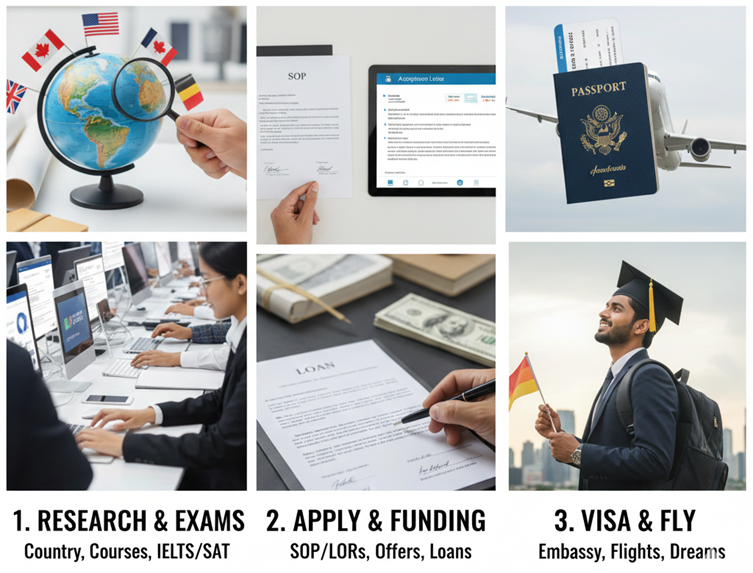
Summary: Thinking about studying abroad right after 12th? You’re not alone! Thousands of Indian students are making this life-changing decision every year. This complete guide walks you through everything you need to know—from choosing the right country and university to handling applications, finances, and settling into your new life. Whether you’re confused about where to start or just need that final push, we’ve got you covered with practical advice, real insights, and honest answers to help you make the best decision for your future.
Why Study Abroad After 12th? (And Is It Really Worth It?)
Let’s be honest—studying abroad sounds exciting, but it’s also scary, right? Leaving home at 18, managing everything on your own, and spending lakhs of rupees. Your relatives might be asking, “Why not just study here?”
Here’s the thing: studying abroad after 12th isn’t just about getting a degree. It’s about experiencing world-class education, building global networks, becoming independent, and yes—opening doors to career opportunities that might take years to access otherwise.
What you actually gain:
- Exposure to cutting-edge research and teaching methods
- A chance to build an international professional network from day one
- Personal growth that comes from navigating a new culture independently
- Better career prospects with global companies
- Potential pathways to work permits and immigration (in countries like Canada, Australia, Germany)
But here’s what nobody tells you: it’s not for everyone. If you’re someone who thrives on challenges, values independence, and is genuinely curious about the world, then yes—it’s absolutely worth it.
Top Countries to Study Abroad After 12th
Choosing the right country is like choosing your adventure. Each destination has its own vibe, costs, and opportunities. Let’s break down the most popular options:
United States – The Land of Opportunities
The US has over 4,000 universities, which means there’s literally something for everyone. From Ivy League prestige to state universities with strong programs, the variety is unmatched.
Why students love it: Flexible education system (you can explore subjects before declaring a major), vibrant campus life, strong alumni networks, and Optional Practical Training (OPT) that lets you work for up to 3 years after graduation.
The reality check: It’s expensive. Tuition can range from $20,000 to $70,000 per year. Scholarships exist but are competitive. Also, getting a student visa has become stricter in recent years.
Best for: Students interested in technology, business, liberal arts, and research-focused programs.
Canada – Affordable Quality with a Clear Path to PR
Canada has become the top choice for Indian students—and for good reason. Quality education, multicultural cities, and a straightforward pathway to permanent residency make it incredibly attractive.
Why students love it: Post-graduation work permits (up to 3 years), lower tuition compared to the US (CAD 15,000-30,000 per year), safe cities, and welcoming immigration policies.
The reality check: Winters are brutal (think -30°C in some cities). Also, with the surge in Indian students, competition for jobs and PR has increased.
Best for: Students looking for quality education with long-term settlement plans.
United Kingdom – Tradition Meets Excellence
Oxford, Cambridge, Imperial, LSE—the UK has a legacy that speaks for itself. Plus, most undergraduate programs are just 3 years (vs 4 years in the US), saving you time and money.
Why students love it: Shorter degree duration, rich cultural experience, central location in Europe (easy travel!), and the Graduate Route visa that lets you work for 2 years post-graduation.
The reality check: Cost of living in cities like London is high. Tuition ranges from £10,000 to £38,000 per year. Weather is gloomy (be prepared for rain).
Best for: Students who want a prestigious degree in a shorter timeframe, especially in fields like law, business, and humanities.
Australia – Sunshine, Beaches, and World-Class Education
Australia offers the perfect blend of excellent universities, a laid-back lifestyle, and sunny weather. Universities like Melbourne, Sydney, and ANU consistently rank in global top 100.
Why students love it: Post-study work visa (2-4 years depending on your degree), high quality of life, strong job market, and opportunities in mining, engineering, and healthcare sectors.
The reality check: It’s far from home (10+ hour flights), and tuition is expensive (AUD 20,000-45,000 per year). Cost of living in cities like Sydney is also high.
Best for: Students interested in engineering, healthcare, environmental sciences, and hospitality.
Germany – Tuition-Free Education (Yes, Really!)
Here’s the kicker: many public universities in Germany charge zero tuition fees—even for international students. You only pay a small semester fee (around €300-400).
Why students love it: Virtually free education, strong engineering and technical programs, and an 18-month post-study work visa. Germany is the economic powerhouse of Europe.
The reality check: Most undergraduate programs are in German, so you’ll need to learn the language (B2 level minimum). Living expenses are still there (€850-1,200 per month). The culture can feel less welcoming initially compared to English-speaking countries.
Best for: Students interested in engineering, technology, and applied sciences who are willing to learn German.
Ireland, Netherlands, New Zealand – Rising Stars
These countries are gaining popularity for good reasons—English-taught programs, post-study work options, and great quality of life. Ireland especially has become a tech hub with Google, Facebook, and Apple headquarters.
Popular Courses to Study Abroad After 12th
Not sure what to study? Here are the fields that attract the most international students and why:
Engineering & Technology
Computer Science, AI, Data Science, Mechanical Engineering—these are evergreen fields with high demand globally. Countries like the US, Germany, and Canada excel here.
Business & Management
BBA, International Business, Entrepreneurship programs give you practical skills and global perspectives. The US and UK are leaders, but European business schools are catching up fast.
Medicine & Healthcare
MBBS abroad (especially in countries like Russia, China, Philippines) is popular because of lower costs and no entrance exams in some cases. Nursing programs in Australia and Canada also have high demand.
Arts, Design & Media
If you’re creative, countries like the UK, Italy, and the US offer incredible programs in fashion, graphic design, film, and animation.
Hospitality & Tourism
Switzerland is the gold standard for hotel management. Australia and New Zealand also offer strong programs with practical training.
Pro tip: Choose based on your interests AND the job market. Research which fields have skill shortages in your target country—this increases your chances of getting work permits after graduation.
Eligibility Requirements – What You Actually Need
Let’s cut through the confusion. Here’s what most universities abroad expect:
Academic Requirements
- Minimum 60-75% in 12th grade (varies by university and course)
- Some competitive programs want 80%+
- Your subject combination in 12th matters (science students can’t directly jump to pure arts courses without foundation programs)
English Proficiency Tests
You’ll need to prove you can study in English. The main tests are:
IELTS: Most common, accepted everywhere. You’ll need a score of 6.0-7.0 overall (most universities want 6.5).
TOEFL: Preferred by US universities. Score of 80-100 is typical.
PTE: Gaining popularity, especially in Australia. Faster results.
Duolingo English Test: Some universities now accept this cheaper, online alternative.
Reality check: If you studied in an English-medium school for 10+ years, some universities waive this requirement. Check individual university policies.
Entrance Exams (Sometimes)
- SAT/ACT for US universities (not always mandatory but helps with scholarships)
- Some countries like UK, Australia, Canada don’t require entrance exams for most programs
- Medicine programs might have their own entrance tests
Other Documents
- Statement of Purpose (SOP) – Your story about why you want to study this course
- Letters of Recommendation (LORs) – Usually 2-3 from teachers
- Updated resume/CV
- Portfolio (for creative fields)
- Financial proof showing you can afford tuition and living costs
Step-by-Step Application Process
Feeling overwhelmed? Break it down into steps, and suddenly it becomes manageable:
Step 1: Research (Start 12-18 Months Before)
Don’t just Google “best universities.” Go deeper. Check:
- University rankings for your specific course (not just overall rankings)
- Alumni reviews on platforms like StudentCrowd
- Career outcomes (what percentage of graduates get jobs?)
- Location (big city vs college town—both have pros and cons)
Step 2: Shortlist 8-10 Universities
Have a mix: 2-3 reach schools (ambitious choices), 4-5 target schools (you have a good chance), 2-3 safety schools (you’ll likely get in).
Step 3: Prepare for Tests (6-9 Months Before)
Book your IELTS/TOEFL slots early. These fill up fast in peak seasons (July-November). Give yourself time for a retake if needed.
Step 4: Prepare Application Materials (6 Months Before)
Start writing your SOP early. It takes multiple drafts to get it right. Request LORs from teachers who actually know you well—generic letters don’t help.
Step 5: Apply (Check Each University’s Deadlines)
- US universities: Deadlines usually between November-January for fall intake
- UK universities: Apply through UCAS, deadline in January for most courses
- Canada, Australia: Rolling admissions, but apply early for better scholarship chances
- Germany: Deadlines vary (May-July for winter semester, November-January for summer semester)
Step 6: Wait for Offers (2-8 Weeks)
Some universities respond in 2 weeks, others take 2 months. Don’t panic—just wait.
Step 7: Accept Offer & Apply for Student Visa
Once you get offers, compare them (not just rankings—consider scholarships, location, program structure). Accept one, pay your deposit, and start the visa process immediately.
Step 8: Arrange Finances
Apply for education loans, scholarship programs, and start saving for initial expenses.
Step 9: Pre-Departure Prep
Book flights, arrange accommodation, attend pre-departure orientations (many universities offer these), pack smart.
Most common mistake: Students wait until 12th results to start the process. Start researching in 11th itself!
Cost of Studying Abroad – The Real Numbers
Let’s talk money. Here’s what you’re actually looking at:
Tuition Fees (Annual)
- USA: $20,000 – $70,000 (₹16-57 lakhs)
- Canada: CAD 15,000 – 30,000 (₹9-18 lakhs)
- UK: £10,000 – 38,000 (₹10-38 lakhs)
- Australia: AUD 20,000 – 45,000 (₹11-24 lakhs)
- Germany: €0 – 20,000 for public universities (₹0-17 lakhs)
- Ireland: €10,000 – 25,000 (₹9-22 lakhs)
Living Expenses (Monthly)
- USA: $800 – 2,000 (₹65,000 – 1,65,000)
- Canada: CAD 1,000 – 1,500 (₹60,000 – 90,000)
- UK: £900 – 1,400 (₹90,000 – 1,40,000)
- Australia: AUD 1,500 – 2,500 (₹82,000 – 1,37,000)
- Germany: €850 – 1,200 (₹75,000 – 1,06,000)
One-Time Costs
- Application fees: $50-150 per university
- Visa fees: ₹13,000 – 40,000
- Test fees (IELTS/TOEFL): ₹15,000 – 17,000
- Flight tickets: ₹40,000 – 1,50,000
- Initial setup (bedding, utensils, winter clothes): ₹50,000 – 1,00,000
Total first-year cost (realistic estimate): ₹25-60 lakhs depending on country
The good news: You can work part-time (most countries allow 20 hours/week during semester), which can cover your living expenses. Students typically earn $10-20 per hour.
Scholarships & Financial Aid – Don’t Leave Money on the Table
Many students don’t even apply for scholarships because they think “I won’t get it anyway.” Big mistake. Here’s where to look:
University-Specific Scholarships
Almost every university offers merit-based scholarships. Some automatically consider you, others need separate applications. These can cover 10-50% of tuition.
Government Scholarships
- Fulbright-Nehru (USA): Covers full costs
- Chevening (UK): Full scholarship for master’s (but you need work experience)
- Australia Awards: Full scholarships for select courses
- DAAD (Germany): Multiple scholarship programs
Private Scholarships
- Tata Scholarships (Cornell University)
- Inlaks Scholarships
- KC Mahindra Scholarships
- JN Tata Endowment
Education Loans
Indian banks (SBI, HDFC, Axis) offer education loans up to ₹1.5 crore with reasonable interest rates. Some countries like Canada have tie-ups with Indian banks offering better terms.
Pro tip: Apply for as many scholarships as you can. Even small ones ($500-1,000) add up!
Student Visa Process – What to Expect
The visa interview is scary for everyone. Here’s how to make it smoother:
Common Requirements Across Countries
- Valid passport (with 6+ months validity)
- University acceptance letter
- Proof of funds (bank statements showing you can pay for tuition + living for 1 year)
- IELTS/TOEFL scores
- Academic transcripts
- Visa application form
- Visa fee payment
- Medical examination (for some countries)
- Biometrics
Interview Tips (Mainly for USA)
- Be honest. Don’t memorize scripted answers.
- Show strong ties to India (family, property, future career plans to return)
- Explain clearly why you chose this university and course
- Have all documents organized in a folder
- Dress formally, be confident but not arrogant
Visa rejection reasons: Inability to prove financial capability, unclear career goals, poor English communication, suspicion of immigration intent (that you won’t return).
Processing time: 2 weeks to 2 months depending on country. Apply early!
Life After Landing – Settling In
You’ve made it! You’re in a foreign country with your luggage and dreams. Now what?
First Week Survival Guide
- Attend university orientation (don’t skip this!)
- Open a local bank account
- Get a local SIM card
- Register with the international student office
- Explore your campus and locate essential places (library, student center, medical clinic)
- Buy groceries and cook your first meal (feels like an achievement!)
Making Friends
Join clubs, attend social events, say yes to coffee invitations. Your cohort will become your support system. Don’t just stick with students from your country—branch out!
Managing Homesickness
It’s real. You’ll miss home-cooked food, family functions, even the chaos. Video calls help, but also build a routine, stay busy, and give yourself time to adjust. It gets better after the first semester.
Part-Time Work
Most countries allow 20 hours/week during semester, full-time during breaks. Campus jobs (library, cafeteria, research assistant) are easier to get initially. Off-campus jobs pay better but need more effort to find.
Budgeting Like a Pro
Track expenses, cook at home (eating out is expensive), use student discounts everywhere, share accommodation, buy second-hand textbooks, use public transport.
Common Myths About Studying Abroad (Let’s Bust Them)
Myth 1: “Only rich students can study abroad.” Reality: With scholarships, part-time work, and education loans, many middle-class students successfully study abroad. It requires planning, not just money.
Myth 2: “You need 90%+ in 12th to get admission.” Reality: Many good universities accept students with 70-75%. It’s about the overall profile—your SOP, extracurriculars, and test scores matter too.
Myth 3: “Foreign degrees guarantee high-paying jobs.” Reality: The degree opens doors, but you still need to work hard, network, gain internships, and build skills. It’s not a magic ticket.
Myth 4: “You’ll forget Indian culture and values.” Reality: Most students actually appreciate their culture more after living abroad. You choose what to keep and what to adapt.
Myth 5: “It’s impossible to get a job abroad after graduation.” Reality: Difficult? Yes. Impossible? No. With the right skills, networking, and persistence, many students secure jobs and work permits.
Is Studying Abroad After 12th Right for You?
Here’s a self-check question list. Be brutally honest:
✅ Are you comfortable being away from family for long periods? ✅ Can you handle cooking, cleaning, and managing finances independently? ✅ Are you open to new cultures and willing to adapt? ✅ Can your family afford/arrange the finances without extreme hardship? ✅ Do you have clear career goals that align with studying abroad? ✅ Are you self-motivated enough to handle freedom responsibly?
If you answered yes to most of these, you’re probably ready.
If you answered no to several, it doesn’t mean you can’t study abroad—just that you need more preparation, maybe wait a year, or consider other options.
Final Thoughts – Your Journey Starts Now
Studying abroad after 12th is one of the biggest decisions you’ll make. It’s exciting, terrifying, expensive, and potentially life-changing—all at once.
Here’s the truth nobody tells you upfront: there will be moments when you’ll question if it was worth it. When you’re eating instant noodles for the fifth time that week, when you miss Diwali at home, when assignments pile up, and homesickness hits hard.
But there will also be moments of pure joy. When you ace that presentation, when you make friends from five different countries, when you travel to places you’ve only seen in movies, when you realize you’ve grown in ways you never imagined.
The question isn’t whether studying abroad is objectively “worth it”—it’s whether it’s worth it for you, given your goals, circumstances, and dreams.
If you’ve read this far, you’re clearly serious about it. So here’s my advice: do your research, talk to current students (not just success stories on Instagram), calculate costs realistically, and then trust your gut.
The world is waiting. Are you ready to take that leap?
Need personalized guidance on studying abroad? Connect with our education counselors at EPS.guru for free consultation, application support, and scholarship assistance. Your dream university is closer than you think!
Have questions? Drop them in the comments below. We read every single one and respond with honest answers—not sales pitches.
Good luck, future global citizen! 🌍✈️